Politics
When the Right to Appeal Comes With a Price Tag: Is Mangaung’s Planning System Really Fair?
Mangaung wants to become a city where development moves faster, investment flows and housing gets built.
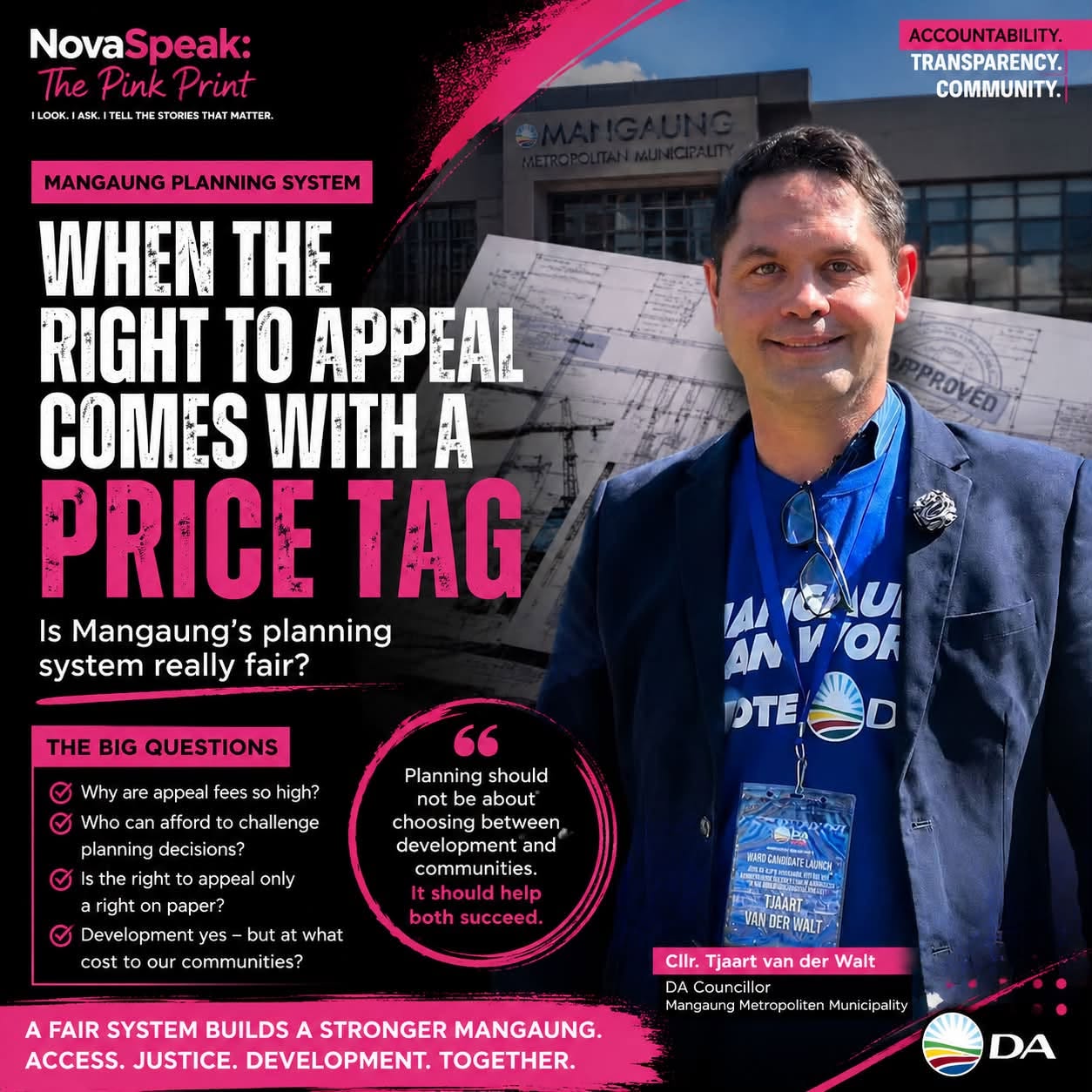
Mangaung wants to become a city where development moves faster, investment flows and housing gets built. But behind the paperwork, planning applications and promises of growth lies a bigger question: what happens when ordinary residents cannot afford to challenge a planning decision that could change their neighbourhood for years to come?
That is the uncomfortable issue now being placed on the table by DA Mangaung councillor Cllr Tjaart van der Walt, who is calling for a review of the municipality’s planning appeal fees. This is not simply a story about paperwork or tariffs. It is a story about who gets a voice when the future of a community is being decided.
Mangaung has made progress in modernising its planning processes, including the introduction of digital building-plan submissions and an increasing recognition of the role councillors can play in representing community interests in land-use applications. The Municipal Planning Tribunal has also made decisions that, according to Van der Walt, demonstrate that development and community interests can be balanced with infrastructure realities.
On paper, that sounds like progress. But then comes the appeal.
Under the municipality’s approved tariffs, someone wanting to appeal a Municipal Planning Tribunal decision must pay an appeal fee equivalent to the fee paid for the original planning application. In some cases, that can mean several thousand rand. For a major developer, it may simply be another administrative expense. For a pensioner, resident, community organisation or small property owner, however, it could be the difference between being able to challenge a decision and simply having to live with it.
And that is where Mangaung’s planning debate becomes much bigger than a tariff schedule.
Imagine a proposed development that could affect traffic, water demand, sewage capacity, density, noise, property values or the character of a neighbourhood. Residents participate. They raise concerns. A decision is eventually made. But if they believe something went wrong and want to appeal, they may first have to find thousands of rand.
Is that meaningful participation?
The DA argues that municipalities are entitled to recover reasonable administrative costs, but says those costs should not become a financial barrier that effectively prevents ordinary residents from exercising their legal rights. Van der Walt has linked the issue to the constitutional principle of access to justice, including Section 34 of the Constitution, which provides for access to courts and, where appropriate, independent and impartial tribunals or forums.
That raises a question Mangaung cannot simply brush aside: if a legal right exists, but exercising that right is unaffordable for many people, how accessible is that right in reality?
At the same time, there is another important side to this debate. A fair planning system cannot simply be designed around objecting to development. Mangaung desperately needs investment, housing, economic activity and responsible development. Developers and property owners also need certainty. They need decisions to be predictable, applications to be processed efficiently and rules to be clear. They also need to know that projects which comply with the law will not be trapped indefinitely in unnecessary bureaucracy.
So perhaps the real question is not whether you are pro-development or pro-community. Perhaps the real question is whether Mangaung can build a planning system where responsible development and community protection actually work together.
The DA says it will engage the municipality on a range of reforms, including reviewing whether appeal fees are fair and proportionate. It is also proposing consideration of reduced or differentiated fees for recognised community organisations and public-interest matters.
But the conversation should go further.
What exactly does Mangaung’s current appeal tariff recover? How many appeals have been lodged, and how many potential appellants may have been discouraged by the cost? How are appeal fees calculated? What mechanisms exist for residents who cannot afford the fee? How easily can residents access planning applications, supporting documents and Municipal Planning Tribunal decisions?
And perhaps most importantly, before major developments are approved, is Mangaung working from current and reliable information about water, sanitation, roads, electricity and other infrastructure capacity?
These are not anti-development questions. They are questions about whether development is being done properly.
Mangaung does not need a planning system that chooses between developers and residents. It needs one that makes both sides trust the rules. A modern planning system should be digital, but it must also be accessible. It should be fast, but not careless. It should encourage investment, but not silence legitimate community concerns. And it should allow residents to challenge decisions without making the price of doing so prohibitive.
Because ultimately, planning decisions are not just about buildings on a map. They determine what our neighbourhoods look like, how infrastructure is used, where people live, how traffic moves and what kind of city Mangaung becomes.
So as Mangaung modernises its planning machinery, perhaps the most important upgrade is not another digital platform. Perhaps it is trust.
And trust begins when residents believe that their voices do not depend on the size of their wallets.
NovaSpeak: The Pink Print
I Look. I Ask. I Tell The Stories That Matter.