Community
A City Learning to Live with Gunfire
A City Learning to Live with Gunfire
Bloemfontein is facing growing concerns over gun violence, illegal firearms and the fear spreading through communities. From the deadly Hamilton shooting to reported hijackings and residents describing regular gunshots in areas such as Heidedal, NovaSpeak examines whether gun violence is becoming normalised — and asks the difficult question: how many more lives must be lost before authorities treat it as a crisis?
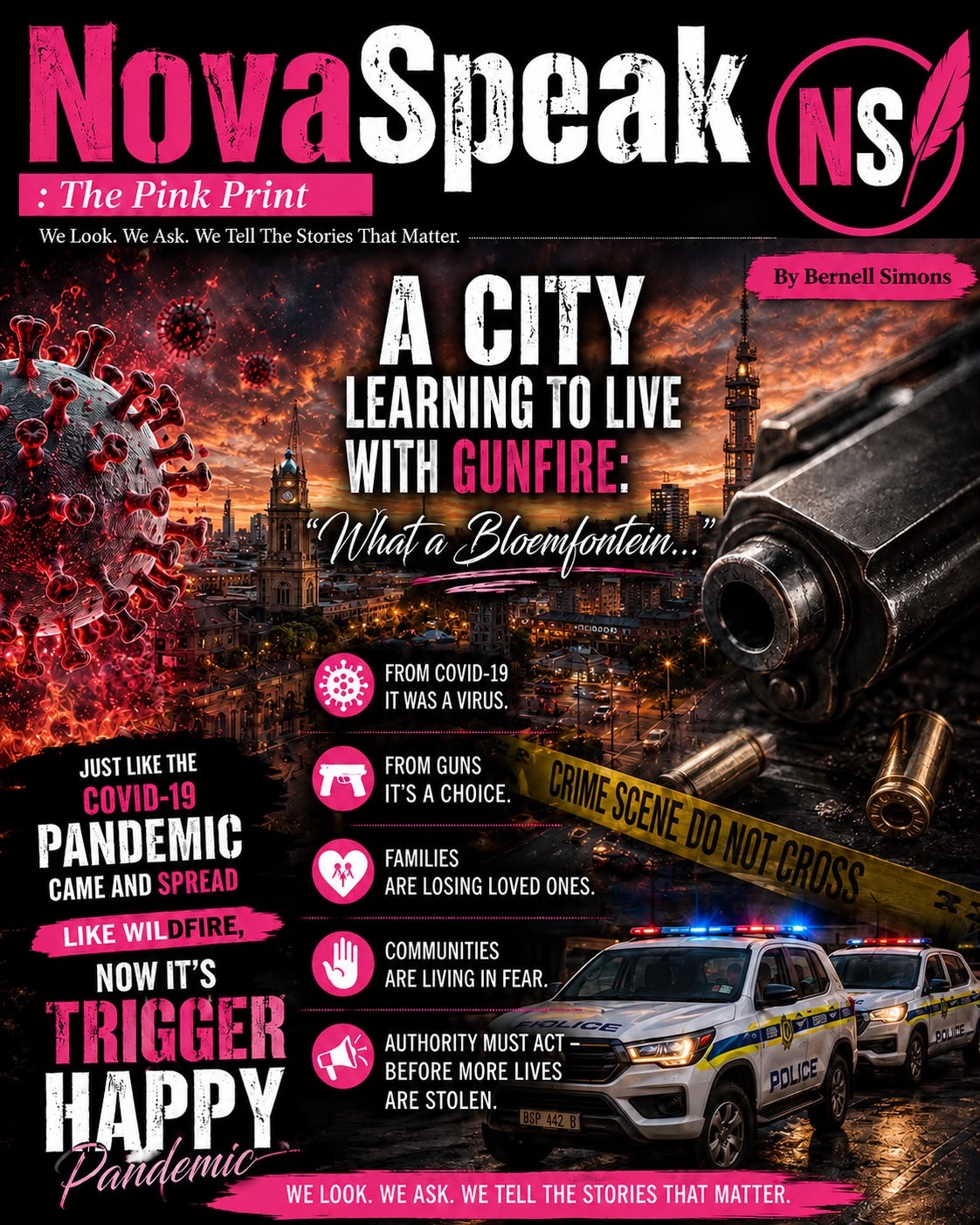
A City Learning to Live with Gunfire: “What a Bloemfontein”
By Bernell Simons
Those were the words of one Facebook user reacting to the latest shocking shooting in Bloemfontein. But buried beneath that seemingly casual response was something far more disturbing: resident Devin Colbert said he had survived a hijacking at the Renosterspruit Bridge in Bloemspruit just two weeks earlier.
Colbert’s reported experience suddenly makes the conversation bigger than one shooting.
It raises a difficult question about what is happening to Bloemfontein and whether residents are slowly becoming accustomed to violence involving firearms.
South Africa has already been described as being in the grip of a gun-violence crisis. Gun Free South Africa reports that approximately 33 people are shot and killed every day in the country.
For communities across South Africa, gunfire is no longer something heard only in crime reports. It is becoming part of the soundtrack of everyday life. Increasingly, residents in parts of Bloemfontein are asking whether the same is happening here.
The latest warning came from Hamilton, where balaclava-clad men armed with high-calibre firearms allegedly attacked a truck driver at a wholesale premises.
The driver was shot and killed, while police opened investigations into murder and attempted murder. CCTV footage of the attack has since circulated on social media.
The footage is disturbing, but perhaps equally disturbing is how quickly such images have become part of the daily social-media cycle. A shooting happens. A video circulates. Residents react. Someone says they heard gunshots. Someone else says they knew the victim. Another person tells a story about being robbed or hijacked. Then the timeline moves on until the next gunshot.
In Heidedal, residents have their own growing concerns. The Hamilton attack did not happen in Heidedal, nor did the reported Bloemspruit hijacking experienced by Colbert, yet these incidents matter to Heidedal because they form part of a broader sense of insecurity that residents say is increasingly becoming part of life in the city. On social-media community platforms, residents regularly report hearing gunshots, particularly over weekends. Then comes Monday morning. Residents wake up, open Facebook and read comments from people saying they heard gunfire during the night. Sometimes there is an explanation.
Sometimes there is not.
That uncertainty creates another danger: ''normalisation''.
When people repeatedly hear gunshots without knowing where they came from, who fired them or whether anyone was injured, the sound can gradually become something they simply learn to live with, but gunfire should never become normal. One of the most chilling observations to emerge from this investigation came from a gun-violence survivor who described how easily an illegal firearm could allegedly be obtained.
He recalled a previous shooting in which both sides were armed.
“We ran from each other while drawing our guns and just started firing,” he explained.
He later recognized how reckless the situation had been, not only because those involved could have killed one another, but because innocent bystanders could have been caught in the crossfire. What shocked him most, however, was the alleged accessibility of the weapon. His description was stark: obtaining the firearm was almost as easy as withdrawing cash from an ATM.
That statement should stop policymakers, police commanders and community leaders in their tracks, because if obtaining an illegal firearm is genuinely that easy, the question is no longer simply:
Who is pulling the trigger? The questions become bigger.
Who is supplying the guns?
Where are they coming from?
How are they entering communities?
How are they moving through criminal networks?
And why do they continue to reach the hands of people prepared to use them?
The Free State’s geography makes those questions particularly important. The province’s proximity to Lesotho and its position along major transport routes make it an area worth examining when considering the movement of illicit goods. But geography alone cannot explain gun violence.
There must also be scrutiny of enforcement, firearm controls, corruption, stolen and lost firearms, illegal trafficking and the effectiveness of investigations.
Professor Mpho Matlala, an Associate Professor in the University of South Africa’s School of Criminal Justice, specializes in policing, crime investigation and police efficiency and ethics. His work and involvement in discussions around firearm trafficking and border management add to the broader conversation about the challenge’s authorities face in preventing illegal weapons from moving through communities.
Gun Free South Africa has also warned that thousands of licensed firearms are reported lost or stolen annually, raising serious questions about firearm management and accountability. The numbers tell their own story. Gun Free South Africa says approximately 33 people are murdered with guns every day in South Africa. Between October and December 2024, SAPS reported 1,952 arrests for illegal possession of firearms and 1,380 arrests for illegal possession of ammunition.
Illegal firearms are therefore not an abstract national problem. They are already moving through communities. They are being carried. They are being used. And increasingly, they are being used in crimes that leave families permanently devastated.
South Africa has attempted to address the problem through firearm amnesty programmes, allowing people to surrender certain unlawfully possessed firearms without facing prosecution for possession itself, subject to legal requirements and exclusions. The principle is straightforward: get illegal firearms out of communities before they are used to kill someone, but surrender programmes cannot succeed on their own. They must be accompanied by effective investigations, intelligence-led policing, proper firearm-control systems, border management and accountability. Otherwise, authorities may remove some weapons from communities while new firearms continue entering the illicit market.
That brings the conversation back to Heidedal.
Residents should not have to wait for a mass shooting before their concerns are taken seriously. They should not have to wait until a child is caught in crossfire. They should not have to wait until a taxi passenger, shopkeeper, teacher, parent or pensioner becomes an innocent victim, and they should not have to become accustomed to saying: “I heard gunshots last night.”
That sentence should trigger concern and investigation — not a shrug.
The Hamilton murder should therefore not be viewed simply as another isolated crime story. It should be considered alongside the stories emerging from Bloemspruit, Heidedal and other parts of Mangaung, where residents describe living with the fear of armed criminals and unexplained gunfire and where Colbert’s reported hijacking experience is one such reminder. His story alone does not prove a wider pattern, but it is precisely the kind of community testimony authorities should be listening to when assessing whether residents are feeling increasingly unsafe.
The phrase “trigger-happy pandemic” resonates because gun violence can spread its consequences through an entire community. Not because it is literally a disease, but because the availability of weapons, criminal networks, retaliation, organised crime, interpersonal conflict, alcohol-fueled violence and the willingness of some individuals to reach for a firearm can create a cycle that is difficult to break.
One person fires a shot.
A family loses a father.
Children lose a parent.
A community loses another resident.
Fear spreads.
Eventually, people begin changing how they live. They avoid certain streets. They stop walking at night. They lock themselves inside earlier. They listen differently when they hear a bang, which is the hidden cost of gun violence, so, who is accountable?
NovaSpeak believes this conversation cannot end with condolences, authorities must answer difficult questions.
How many illegal firearms have been recovered in Mangaung this year? How many firearms used in murders and attempted murders have been traced back to their original legal owners or points of theft? How many cases involving illegal firearm possession have resulted in convictions? How many firearms have been reported lost or stolen from licensed owners, security companies and state institutions in the Free State? What intelligence operations are currently targeting firearm-trafficking networks supplying Mangaung?
Perhaps the most uncomfortable question of all: At what point does the repeated sound of gunfire become evidence of a crisis rather than simply another weekend crime report?
Heidedal residents should not have to wait until their community appears in the national headlines to be heard. The Hamilton truck-driver shooting is a tragedy. The reported Bloemspruit hijacking is another warning. The reports of gunshots in Heidedal are another.
Individually, they are incidents, collectively, they demand scrutiny. Bloemfontein cannot afford to become a city where people hear gunshots, scroll past the videos, read the comments and simply carry on with Monday morning. We simply cannot normalise the sound of gunfire. The question is no longer whether Bloemfontein has a gun-violence problem, the question is how bad it has to become before authorities treat it like the crisis residents already believe it is.
NovaSpeak: The Pink Print
We Look. We Ask. We Tell The Stories That Matter.