Crime
HEIDEDAL’S DRUG WAR
WHO IS PROTECTING OUR CHILDREN?
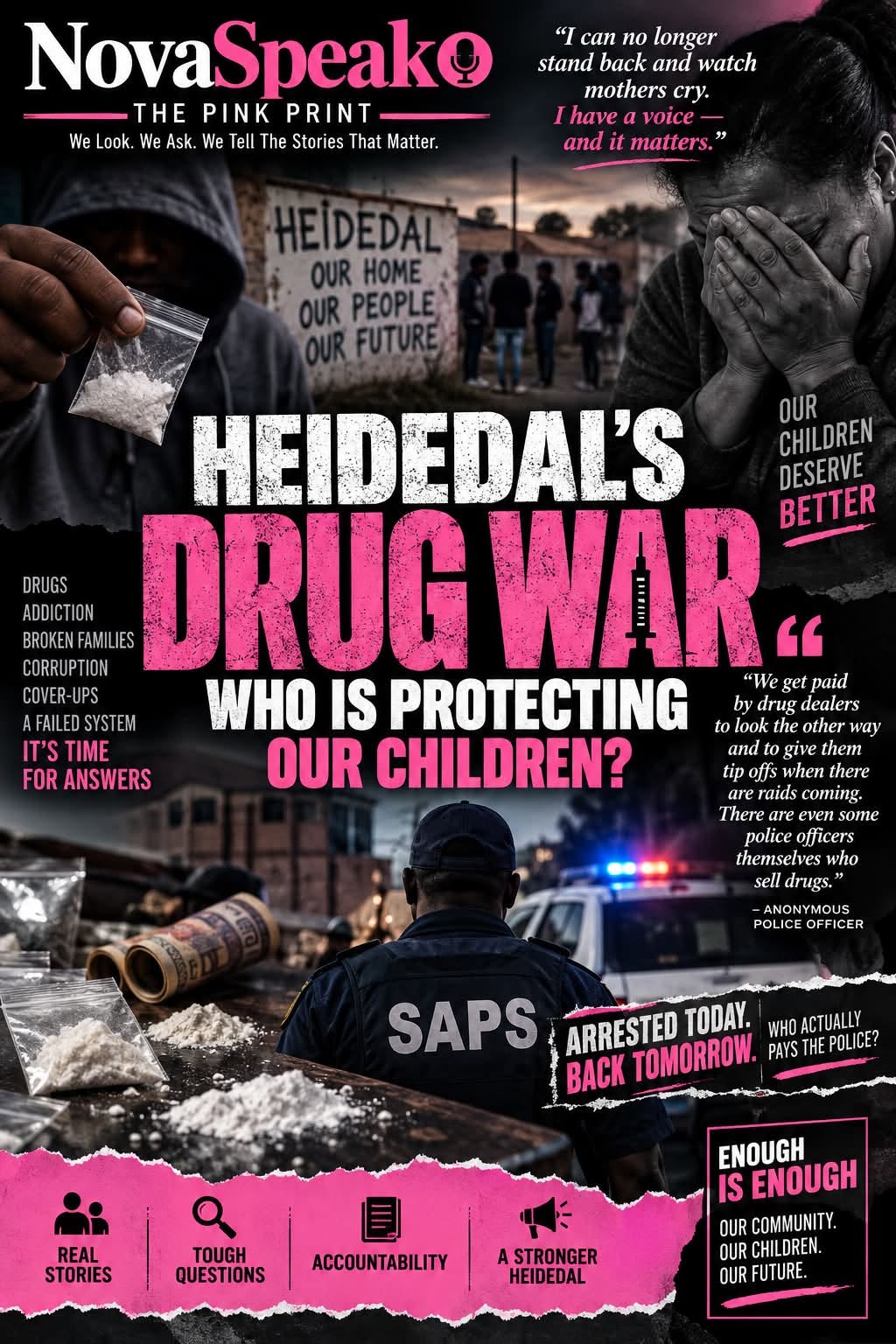
WHO IS PROTECTING OUR CHILDREN?
“I can no longer stand back and watch mothers cry. I have a voice — and it matters.”
There comes a point where silence is no longer an option. For me, that point has arrived. I can no longer stand back and watch mothers cry, families break apart and young people fight battles with addiction while those profiting from the destruction of our community allegedly continue to operate. Heidedal is hurting, and behind the closed doors of homes across the community, mothers are fighting battles that many people never see. They watch their children become trapped in addiction, borrow money, sell possessions, plead with them to change and spend sleepless nights wondering whether the child they raised will make it home. While families carry that pain, however, somebody is making money — and that raises a question that can no longer be whispered behind closed doors: Who is really protecting Heidedal?
NovaSpeak has been speaking to people with knowledge of the drug problem in the community, and during our investigation, a police officer who requested anonymity made an allegation that is as disturbing as it is serious. The officer claimed that some police officers are allegedly being paid by drug dealers to look the other way and provide information about impending police operations. The officer told NovaSpeak: “We get paid by drug dealers to look the other way and to give them tip-offs when there are raids coming. There are even some police officers themselves who sell drugs.” These allegations have not been independently verified by NovaSpeak and should not be interpreted as proof that any particular police officer is corrupt or involved in drug dealing. The officer’s identity has been withheld because of the sensitivity of the allegations and concerns about possible repercussions. But allegations of this nature cannot simply be dismissed because they are uncomfortable. They demand investigation, they demand answers and they demand that the relevant authorities establish whether there is any truth behind what this officer claims.
What is not in dispute is that drug addiction has consequences far beyond the individual using drugs. It affects mothers, fathers, siblings, children, schools, households and the wider community. Residents have repeatedly raised concerns about drug dealing and the impact of addiction in Heidedal. The existence of those concerns is one thing; establishing the full scale of the networks behind the street-level trade is another. Who supplies the drugs? Who distributes them? Who finances the operations? Who profits? Who protects the networks? And, if the allegations made to NovaSpeak are found to have substance, is anybody within law enforcement assisting those networks?
Those are the questions that matter because catching the person selling drugs on a street corner may remove one individual from the equation, but it does not necessarily dismantle the operation behind them. If another dealer simply takes that person's place, the community has not won the war. It has merely witnessed another temporary interruption in a much larger business. The real investigation has to move beyond the person standing on the street and towards the people supplying the drugs, financing the trade and collecting the profits.
That is also why residents' frustration about arrests deserves closer examination. One of the questions repeatedly asked in communities affected by drug dealing is simple: How does somebody get arrested for an alleged drug offence and seemingly end up back on the streets days later? There are legitimate legal reasons why an accused person may be released. Bail exists. Cases require evidence. Prosecutors must prove allegations in court. Investigations can encounter procedural and evidentiary challenges. An arrest is not a conviction, and being released does not automatically mean that a case has failed. But that legal reality should not prevent communities from asking whether the system is functioning effectively. If the same individuals are repeatedly arrested and repeatedly return to the same environment, authorities should be able to explain what is happening. Are cases being properly investigated? Are sufficient resources being dedicated to drug investigations? Are prosecutors receiving the evidence they need? Are repeat offenders being identified? Are financial investigations being conducted? And most importantly, are authorities going after the people higher up the supply chain?
Because if law enforcement repeatedly removes people from street corners while the suppliers remain untouched, the problem simply regenerates.
That brings the police allegation into even sharper focus. This is not an accusation against every member of the South African Police Service. There are police officers working under difficult and sometimes dangerous circumstances who genuinely want to protect their communities. There are officers who put themselves at risk to confront criminals and protect residents. But that is precisely why credible allegations of corruption must be taken seriously. If even one police officer accepts money from a drug dealer, the damage does not stop with that individual. It damages public trust, potentially compromises investigations, gives criminal networks access to information they should never have and creates the devastating perception that the very system established to protect residents may itself be compromised.
The question, therefore, is not whether every police officer is corrupt. That would be reckless and unfair. The question is whether allegations of corruption are being properly investigated when they arise.
NovaSpeak believes SAPS should be able to answer that question directly. Are there current investigations into allegations that police officers in or around Heidedal are receiving money from alleged drug dealers? Have allegations that sensitive information about planned raids is being leaked to criminal networks been investigated? Are there disciplinary or criminal investigations involving SAPS members allegedly linked to drug trafficking or drug dealing? How many SAPS members in the relevant area have been disciplined or prosecuted for alleged corruption connected to drug-related offences? What safeguards exist to prevent operational information from reaching criminal networks? How does SAPS investigate allegations made by its own members against fellow officers? What mechanisms exist to protect whistleblowers who provide information about alleged police corruption? And how many drug-related arrests in the area have ultimately resulted in successful prosecutions and convictions?
These are not unreasonable questions. They are questions that emerge naturally when allegations of this seriousness enter the public domain. The community deserves reasonable answers.
The responsibility also cannot rest solely with an individual police station. Provincial authorities and law-enforcement oversight structures have a role to play in determining whether allegations involving organised crime and police corruption are being escalated appropriately. If criminal networks are operating in Heidedal, are intelligence-led investigations being conducted against those networks? Are suspicious financial relationships involving officials being examined? Are authorities following the money rather than simply counting arrests? And when allegations are made that police officers themselves may be involved in criminal activity, who investigates the investigators?
That may be the most important question of all.
Because we must stop talking about addiction as though it only affects the person taking the drugs. It does not. Addiction walks through the front door of a family home. It sits at the dinner table. It drains household finances. It creates fear. It destroys trust. It changes children. It breaks relationships. It keeps mothers awake at night. And sometimes it leaves families wondering whether they will ever get their child back.
For every person counting money from the drug trade, there is potentially a mother counting the hours until her child comes home. For every dealer celebrating another sale, there may be a family dealing with another crisis. Behind every statistic is a human being, and behind many of those human beings are families carrying a burden that they never asked for.
Our children are not a business model.
They are someone's son. Someone's daughter. Someone's brother. Someone's sister. Someone's future.
And that is why silence is no longer an acceptable response.
There will be people who say this is too dangerous. There will be people who say nothing will change. There will be people who argue that asking these questions will only create more problems. But journalism that refuses to ask difficult questions when communities are hurting is not serving those communities. At the same time, investigative journalism carries a responsibility of its own. NovaSpeak will not declare someone guilty without evidence. We will not publish names simply because somebody makes an allegation. We will seek responses. We will examine evidence. We will follow documents. We will follow cases. We will listen to residents. And where identifiable individuals are accused of wrongdoing, they must be given a fair opportunity to respond.
Because this investigation is not about creating fear.
It is about uncovering the truth.
If drug networks are operating in Heidedal, they must be dismantled. If people are profiting from addiction, the evidence should expose them. If police officers are being corrupted, those allegations must be investigated and, where wrongdoing is established, accountability must follow. If innocent officers are being falsely accused, their names must be cleared. If criminal cases are collapsing because of failures within the system, those failures need to be identified. And if somebody inside the system is protecting those allegedly destroying the community, that person must be held accountable through the proper legal and disciplinary processes.
Because Heidedal cannot afford another generation sacrificed to addiction.
The mothers of this community deserve answers. Our children deserve protection. Honest police officers deserve an institution they can be proud to serve. And residents deserve confidence that the people entrusted with protecting them are actually doing everything within their power to do so.
Which brings us back to perhaps the simplest question of all:
Who actually pays the police?
The answer should be the public.
Not drug dealers. Not criminal networks. Not anyone operating outside the law.
If evidence ever establishes that criminals are paying people entrusted with enforcing the law, then the issue is no longer merely about drugs. It becomes a question about the integrity of the entire system — a system on which ordinary families depend when they call for help, report a crime or send their children into the streets believing they are protected.
Heidedal has every right to ask whether that system is working.
It has every right to demand that allegations be investigated.
It has every right to demand that evidence be followed.
And it has every right to expect that those entrusted with protecting the community will stand on the side of the community.
Because mothers should not have to fight drug dealers alone.
Families should not have to investigate criminal networks themselves.
And children should not have to grow up believing that addiction, dealing and criminality are simply part of life.
There comes a point where silence becomes part of the problem.
For me, that point has arrived.
I can no longer stand back and watch mothers cry.
I have a voice.
And it matters.
NovaSpeak | The Pink Print
We Look. We Ask. We Tell The Stories That Matter.