Opinion
WHO REALLY HOLDS THE POWER?
Inspired by a thought shared on Facebook by Damien Dae Theys.
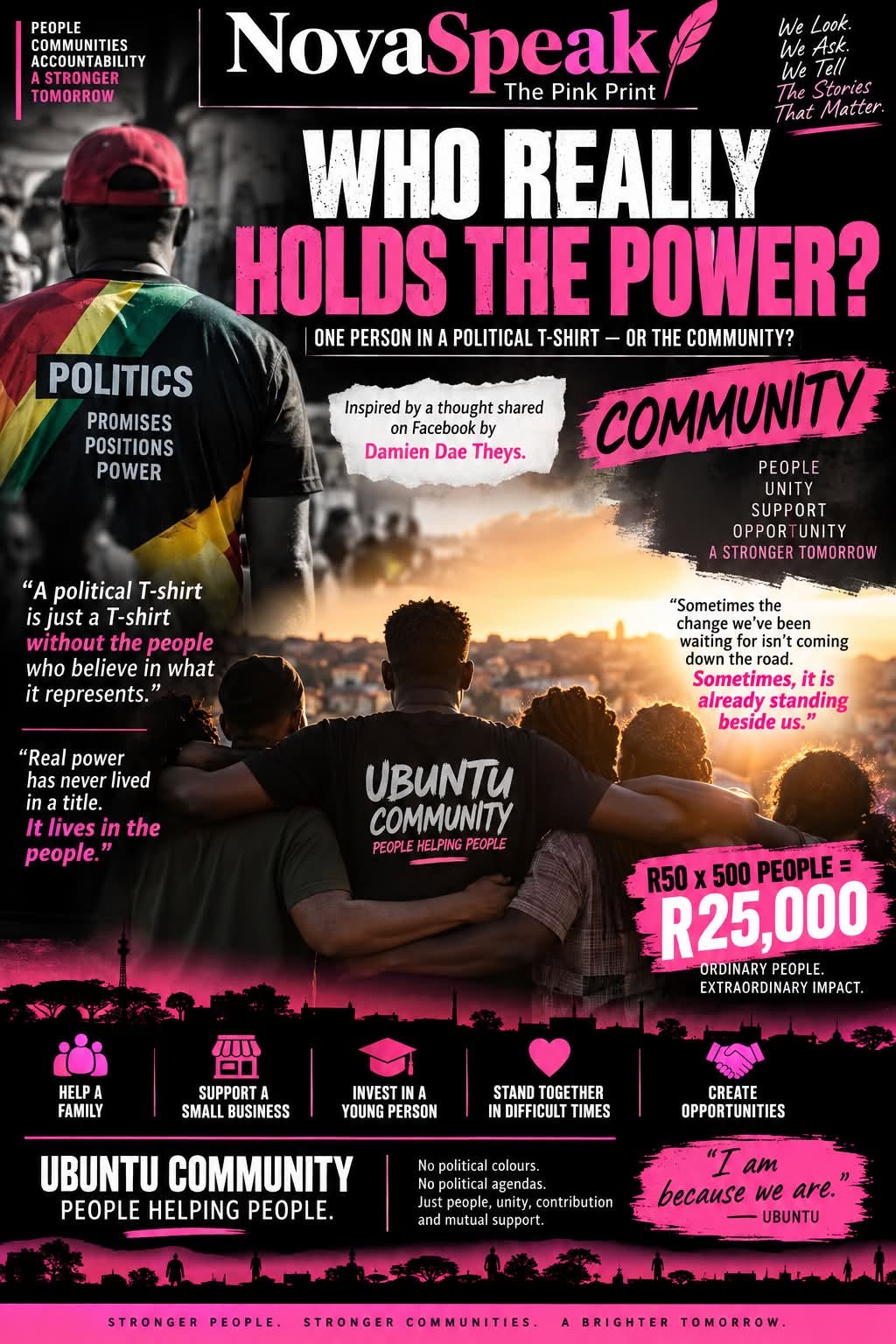
The real power in a community may not sit with a political party, a councillor or a government office — it may already be in the hands of the people themselves.
That is the question raised by a recent thought shared on Facebook by Damien Dae Theys, which prompted a broader reflection on how communities understand power, responsibility and change. In an environment where political colours often dominate public conversations, it is easy to believe that solutions must always come from political organisations or elected representatives. But a political organisation cannot exist without people, a leader cannot lead without people willing to follow, and a community representative cannot represent a community that refuses to participate.
A political T-shirt, by itself, has no power. The power is in the people wearing it.
That simple idea may be worth considering at a time when communities are increasingly being asked to vote, support campaigns and place their trust in political promises. Instead of constantly asking which political party will save a community, perhaps the more difficult question is what that community can do for itself — and what becomes possible when ordinary residents begin recognising the resources they already possess.
Those resources are not insignificant. Communities are filled with people with skills, ideas, businesses, networks, resources, experience and connections. Yet despite that potential, many communities have become accustomed to waiting: waiting for politicians, waiting for government, waiting for funding and waiting for someone else to arrive with a solution.
The problem is that life does not wait.
Families are struggling today. Young people need opportunities today. Small businesses need support today. Pensioners need assistance today. And sometimes the person capable of making a difference is not sitting in Parliament, inside a municipal office or behind a political podium. Sometimes that person is sitting next door.
That thinking sits at the centre of Ubuntu Community, a community initiative built around the principle of people helping people. It is not presented as another political organisation or campaign vehicle, but rather as an attempt to encourage people to recognise the collective strength that exists within their own communities.
The idea is deliberately simple. If 500 ordinary people each contributed R50, the combined amount would be R25,000. The significance, however, is not only the money. It is the possibility created when 500 people realise that they do not always have to wait for somebody else to change their circumstances. They can contribute to changing them themselves.
That contribution could take different forms. Today, it could help a struggling family. Tomorrow, it could assist someone trying to establish or expand a small business. On another day, it could help a young person pursue an opportunity, support someone through a difficult period or simply remind a neighbour that they have not been forgotten. The collective impact grows when people stop measuring their individual contribution in isolation and begin considering what hundreds of people can achieve together.
This does not mean communities should stop demanding accountability from government. Government has responsibilities, and residents must continue demanding proper service delivery, responsible leadership and transparency from those elected or appointed to serve them. But community responsibility cannot begin and end at the ballot box. Voting provides citizens with a political voice, but unity and collective contribution can turn that voice into practical community action.
That also means Ubuntu Community does not require people to agree politically. Residents do not have to support the same party, wear the same colours, vote for the same candidates or share identical views. In fact, the strength of the concept may lie precisely in its ability to operate across those differences.
A community can disagree politically while still recognising a shared responsibility to one another.
The person next door may vote differently, but they still live in the same neighbourhood. Their struggle can still affect the wider community. Their business can still create employment. Their success can still inspire somebody else. Their skills can still benefit people around them.
That is where the principle of Ubuntu becomes more than a slogan. It becomes a recognition that people's lives are connected. Your struggle can become my concern. Your success can become our inspiration. Your opportunity can create an opportunity for somebody else.
When one person falls, another can reach out a hand. When one family is struggling, another family may be able to help. When one person has a skill or resource to offer, a community can create the space for that contribution to have meaning.
And perhaps that is where real community power begins — not with a political T-shirt, a title or a microphone, but with ordinary people deciding that they are no longer prepared to stand alone.
The challenge, then, is not to replace government or allow politicians to escape their responsibilities. It is to recognise that communities have responsibilities too. Waiting for government does not prevent people from helping one another, just as demanding accountability from political leaders does not prevent residents from taking practical steps to strengthen their own communities.
For too long, the question has often been framed as: “Who is going to help us?”
Perhaps the more powerful question is: “What can we do when we decide to help one another?”
Because the greatest resource in any community is not a political party. It is not a councillor. It is not a government office.
It is the people.
That is the idea at the heart of Ubuntu Community: people helping people, without political colours, without political agendas and without one individual owning the community.
The power may never have belonged entirely to those standing on political stages in the first place.
Perhaps it has always belonged to the people standing in the streets, running the businesses, raising the children, supporting their neighbours and deciding whether they will continue waiting for change — or become part of creating it.
Sometimes the change we have been waiting for is not coming down the road.
Sometimes, it is already standing beside us.
UBUNTU COMMUNITY
PEOPLE HELPING PEOPLE. 🤝🏾
NovaSpeak | The Pink Print
We Look. We Ask. We Tell The Stories That Matter.