News
AN EYE FOR AN EYE
SHOULD SOUTH AFRICA RETHINK THE DEATH PENALTY?
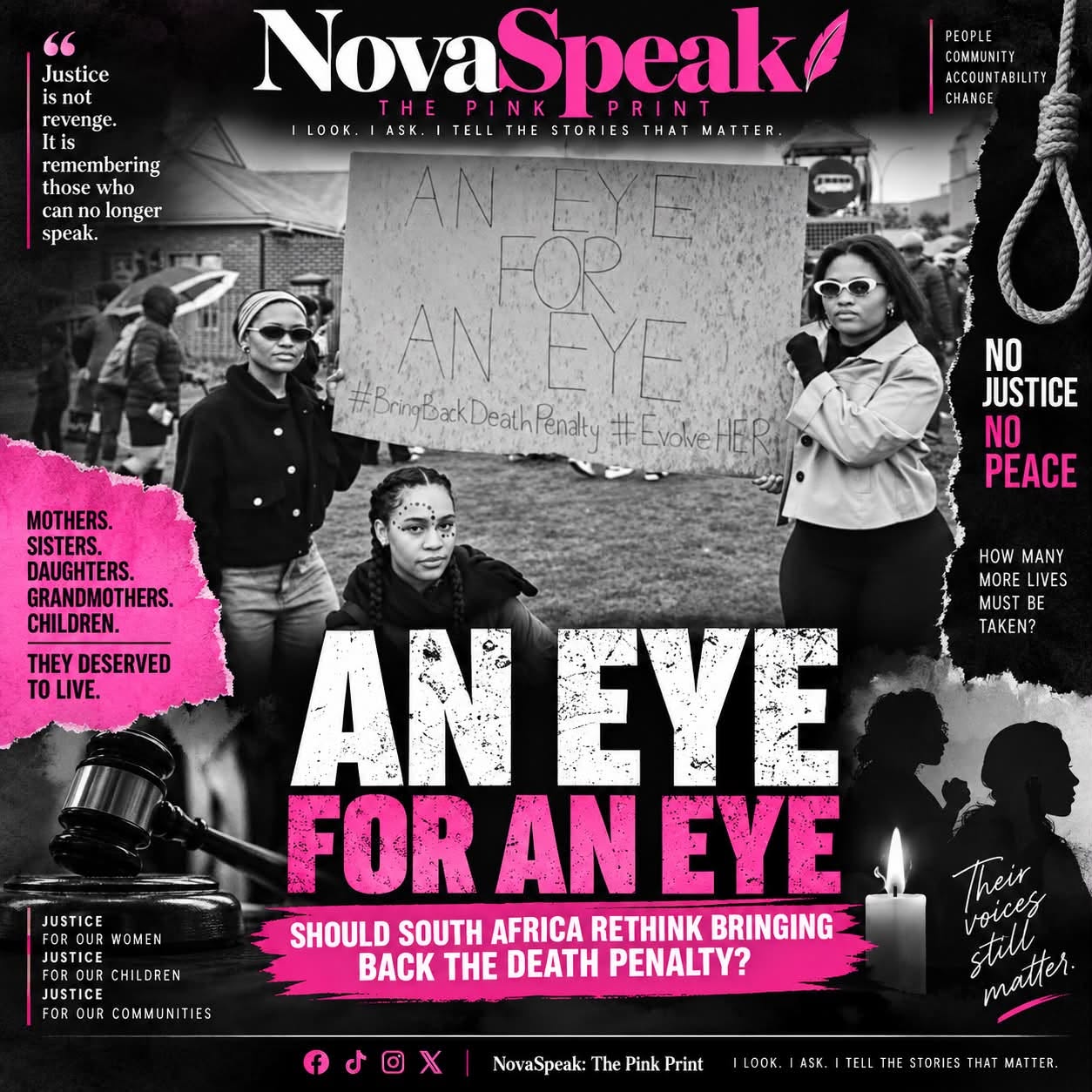
South Africa has abolished the death penalty, but the question of whether it should ever return refuses to die.
For families who have buried mothers, daughters, sisters, grandmothers and children because of violent crime, the debate is not an abstract constitutional argument. It is personal. It is the empty chair at the dinner table, the unanswered phone call, the birthday celebrated without someone who should have been there and the child who grows up knowing that a parent is never coming home.
And that raises an uncomfortable question: what form of justice does a country owe to families whose loved ones have been deliberately taken from them?
NovaSpeak believes South Africa should be willing to have that conversation again — not as a call for revenge, and not through political slogans, but through evidence, constitutional scrutiny, the realities of violent crime, the condition of the correctional system and, most importantly, the voices of victims' families.
The photograph accompanying this article carries three words that capture the rawest version of the argument: “An eye for an eye.”
For some, those words represent justice proportionate to the crime. For others, they represent a dangerous return to state-sanctioned killing and a punishment that cannot be undone if the courts get it wrong.
Both arguments deserve to be confronted.
South Africa's Constitutional Court effectively closed the door on capital punishment in S v Makwanyane, finding the death penalty unconstitutional and emphasising, among other considerations, the rights to life and dignity and the possibility of irreversible judicial error.
That possibility remains one of the strongest arguments against capital punishment.
But there is another reality that cannot simply be dismissed because it is uncomfortable.
When a person is murdered, the punishment does not end with the conviction of the perpetrator. For the victim's family, the consequences can last for generations.
A mother loses a daughter.
Children lose a mother.
A brother loses a sister.
A family loses a grandmother.
The sentence imposed by a court may eventually expire, but the family's grief does not.
There is no parole hearing that brings the victim back. No rehabilitation programme can restore the family to what it was before the murder. There is no release date for grief.
That is where the death-penalty debate becomes particularly difficult.
It is also where South Africa's correctional system enters the conversation.
The question is not simply whether convicted murderers should die. It is whether the punishment system is achieving the purposes for which it exists — punishment, rehabilitation, protection of society and eventual reintegration where appropriate — while operating under enormous pressure.
The Department of Correctional Services recorded an inmate population of 166,924 against 107,346 available bed spaces at the end of December 2024, amounting to overcrowding of about 56%. The department has acknowledged that overcrowding increases security risks, limits access to services and places immense pressure on correctional officials.
By 2026, the department was still reporting overcrowding of about 58%, while simultaneously facing significant fiscal pressure and a reduction of almost R700 million in its budget.
These figures do not, by themselves, prove that the death penalty would solve South Africa's prison crisis.
They do, however, demonstrate the scale of the problem.
And then there is the human experience inside the system.
NovaSpeak recently spoke to a former inmate who had spent six years behind bars.
His response was unexpected.
“I wish I could go back because there I had no stress.”
The statement should not be interpreted as evidence that prisons are comfortable, nor should one former inmate's experience be presented as representative of the entire correctional population.
But it should make South Africa uncomfortable.
What does it say about life after prison if someone who spent six years incarcerated remembers prison as less stressful than life outside?
What does that tell us about rehabilitation?
What does it tell us about reintegration?
What does it tell us about the conditions facing former offenders once they return to communities?
And perhaps most importantly, what does it tell us about whether the correctional system is actually achieving the objectives society expects from it?
These questions matter because South Africans are not only asking what happens to offenders after conviction. Increasingly, they are asking what happens to victims.
For years, public debate around criminal justice has often focused heavily on the rights and rehabilitation of offenders. Those rights are constitutionally protected and cannot simply be discarded.
But victims have rights too.
Families have rights too.
Communities have rights too.
A justice system that protects the constitutional rights of an accused person must also ensure that victims are not reduced to case numbers once the funeral is over.
This is not an argument that imprisonment should be replaced by execution simply because incarceration costs money. The state has a constitutional obligation to administer justice, protect society and operate correctional facilities.
But taxpayers are ultimately funding the correctional system, and the financial and social consequences of long-term incarceration are legitimate issues for public debate.
If an offender spends decades behind bars, society carries the cost of that incarceration for decades.
At the same time, if the offender is eventually released, society must confront another question: has that person been rehabilitated, or has the system merely delayed the next potential crime?
There is no easy answer.
And that is precisely why the death-penalty debate should not be reduced to emotion on one side and constitutional law on the other.
The emotion is real.
The law is real.
The prison crisis is real.
The possibility of wrongful conviction is real.
The pain of victims' families is real.
South Africa therefore faces a much larger question than simply whether it should execute convicted murderers.
It must ask whether its current approach to violent crime is delivering justice, protecting communities and creating meaningful consequences for those who deliberately take innocent lives.
Because for a family sitting through a murder trial, justice is not theoretical.
It is a mother sitting in a courtroom.
It is a child waiting outside.
It is a grandmother carrying a photograph of someone who should still be alive.
It is a family returning from a cemetery knowing that the person they buried will never walk through their front door again.
And while the convicted offender may one day have a parole hearing, that family will never have a hearing at which someone says their loved one is coming home.
There is no rehabilitation for death.
There is no parole from grief.
There is no sentence that makes the victim's family whole again.
That is the uncomfortable truth sitting at the centre of this debate.
South Africa cannot ignore the constitutional arguments against capital punishment. The possibility of judicial error, the right to life, human dignity and the irreversible nature of execution demand the highest level of scrutiny.
But neither can the country ignore the growing frustration of communities who believe that violent criminals have more meaningful rights than the people they have harmed.
If South Africans are expected to trust the justice system, victims cannot be treated as an afterthought.
If prisons are intended to punish, rehabilitate and protect society, citizens have the right to ask whether the system is achieving those objectives.
And if the death penalty remains permanently off the table, then government must be able to demonstrate that the alternative is strong enough to protect the public, deter serious crime where possible, rehabilitate those who can be rehabilitated and keep dangerous offenders away from communities when necessary.
Perhaps, then, the question is not simply:
Should South Africa bring back the death penalty?
Perhaps the deeper question is:
What does justice owe to a family whose loved one was deliberately taken from them?
That question has no comfortable answer.
It should not.
Because every side of this debate involves human lives.
So, an eye for an eye?
South Africa may not be ready — constitutionally, legally or morally — to answer that question with capital punishment.
But it should be brave enough to ask the question.
And it should be brave enough to listen to the people who have already paid the highest price.
NovaSpeak: The Pink Print
We Look. We Ask. We Tell The Stories That Matter.