Health
HOW MANY MORE LIVES?
HEIDEDAL FAMILY WAITED FOR AN AMBULANCE THAT NEVER CAME
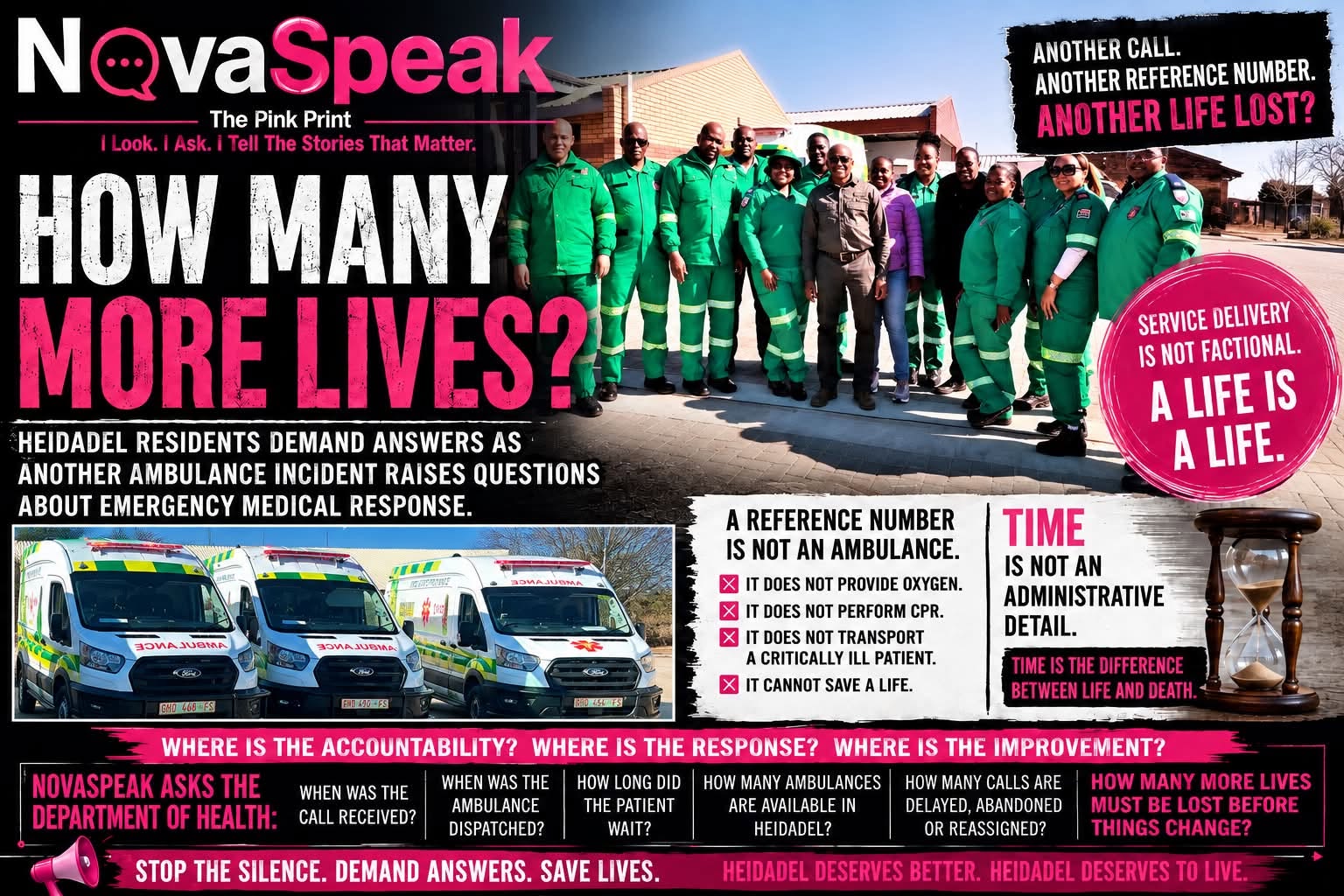
How many more lives must be lost before emergency medical response in Heidedal becomes an urgent public accountability issue?
That is the question now confronting the Free State Department of Health after a Heidedal family says they spent hours waiting for an ambulance on 20 August 2026, watching their critically ill loved one deteriorate before he died at approximately 11:00. The family says an emergency call was made between approximately 06:00 and 07:00 that morning.
A reference number was issued.
They were told to wait.
And they waited.
The family lives along Dr Belcher Road, one of Heidedal’s busiest streets and the same road where Pelonomi Hospital is situated. According to the family, ambulances could be seen travelling along the road while they waited for one to come to them.
“We stay in one of busiest streets, Dr Belcher Road, the same road where Pelonomi Hospital is. There were so many ambulances passing by and every time one passed, we hoped it was for us.”
But, according to the family, the help they were waiting for never arrived and at approximately 11:00, their loved one died.
The circumstances raise a serious public-interest question:
What happened between the moment the family called for emergency assistance and the moment their loved one died?
NovaSpeak has approached Free State Department of Health spokesperson Mondli Mvambi, but unfortunately " NO ANSWER, NOT EVEN AN I WILL GET TO YOU " for answers regarding the incident.
The questions were formally put to the Department.
No response had been received by the time of publication.
That silence is particularly significant because the reference number issued to the family could potentially provide the key to reconstructing what happened.
It could allow the Department to establish when the emergency call was received, what information was recorded, what priority was assigned, whether an ambulance was dispatched, when it was dispatched, which unit was assigned, whether a crew was available, whether the call was escalated and how the incident was ultimately recorded.
It could also establish whether the original emergency call was recorded and whether dispatch or GPS records exist. Those records should be preserved, because this is no longer simply a question of one family’s account versus a government department’s account.
There may be a documented timeline and that timeline should be capable of answering the most basic question:
What happened after the family called for help?
NovaSpeak is not claiming that the absence or delay of an ambulance medically caused the man’s death.
That determination would require the relevant medical, emergency-service and investigative evidence, but a reported emergency response that allegedly lasted for hours while a critically ill patient deteriorated is unquestionably a matter of public interest and it becomes even more concerning because this is not the first incident to raise concerns about emergency medical assistance in the wider Heidedal community.
ANOTHER FAMILY, ANOTHER DEATH
Approximately a month earlier, residents in the Ashbury community reportedly faced another emergency involving an elderly woman who required an ambulance.
According to information provided to NovaSpeak, the woman’s family repeatedly called for emergency assistance but experienced delays. She ultimately died.
Again, NovaSpeak is not presenting an ambulance delay as the medically established cause of death without the necessary evidence, but when two reported incidents involving emergency medical assistance occur within a relatively short period, the question becomes bigger than two individual cases.
How many emergency calls can a community make before the emergency-response system itself becomes the story?
Two families.
Two deaths.
Two sets of questions.
And a community demanding to know whether emergency medical services are reaching residents when they need them most.
BLOEMFONTEIN’S AMBULANCE ROSTER WAS SUPPOSED TO INCREASE FROM 9 TO 14
The latest incident becomes even harder to ignore when viewed against the government’s stated expansion of emergency medical capacity in Mangaung.
Recent reporting on the Free State’s ambulance rollout indicates that the number of rostered ambulances in Mangaung Metro is expected to increase from 14 to 26.
More specifically, the reported allocation shows Bloemfontein increasing from 9 rostered ambulances to 14.
Botshabelo is reported to increase from three to seven ambulances, while the broader Mangaung Metro allocation rises substantially. (Instagram)
That means Bloemfontein is expected to have five additional rostered ambulances.
And that raises a straightforward question:
If Bloemfontein’s rostered ambulance capacity has been increased from 9 to 14, why is a Heidedal family still reporting hours of waiting for emergency assistance?
NovaSpeak is not suggesting that the additional ambulances automatically guarantee a particular response time. Nor is NovaSpeak suggesting, without official evidence, that an ambulance delay caused the death reported on 20 August, but increased capacity creates a legitimate accountability question.
If the system has been strengthened, is that improvement reaching the people who need it?
Because an ambulance fleet is only meaningful when vehicles are:
Operational.
Staffed.
Available.
Dispatched.
And ultimately:
Able to reach the patient.
Five additional rostered ambulances in Bloemfontein should therefore prompt a very practical question:
What difference are those additional resources making on the ground in communities such as Heidedal?
Are response times improving?
Are fewer emergency calls being delayed?
Are more ambulances available during peak periods?
Are there enough EMS personnel to operate the vehicles?
And when all available ambulances are occupied, what contingency system is activated?
A reference number proves that an emergency call was logged, but it does not treat a patient, administer emergency care, transport someone to hospital, or reassure a family watching a loved one deteriorate. The real measure of an emergency-response system is what happens after that reference number is issued: When was the call received? What priority was assigned? When was an ambulance dispatched? Where was the nearest available ambulance? Was a crew available? Was the vehicle already responding to another emergency? Was the call escalated? How long did the patient wait, and if there was a delay, why? These are not political questions; they are public-interest questions. A heart attack does not ask which political party a person supports. A stroke does not check whether someone belongs to one faction or another. A child struggling to breathe does not care who sits in council. A medical emergency is not factional. A human life is not political.
NOVASPEAK PUT THE QUESTIONS TO THE DEPARTMENT
NovaSpeak formally approached Mondli Mvambi, spokesperson for the Free State Department of Health, and put detailed questions to the Department concerning the 20 August incident.
Among the questions submitted were:
Did the Department receive an emergency call from the Heidedal family between approximately 06:00 and 07:00 on 20 August?
At what exact time was the call received?
What information was recorded about the patient’s condition?
What priority was assigned to the call?
Was an ambulance dispatched?
If so, at what time was it dispatched and which unit was assigned?
Was an ambulance available in or near Heidedal when the call was made?
Was a crew available to respond?
Did the family make subsequent calls or request an escalation?
What was the recorded response time?
Did an ambulance or EMS crew eventually reach the address?
Does the Department have a recording of the original emergency call?
Does it have dispatch logs, incident records or GPS information relating to the response?
Was the incident recorded as a delayed-response complaint?
Has an internal investigation been launched?
NovaSpeak also asked the Department about the broader EMS situation in Heidedal and Bloemfontein, including:
* The number of ambulance-delay complaints received from the area;
* Average EMS response times;
* The number of calls exceeding prescribed response targets;
* The number of ambulances currently operational in Bloemfontein;
* Whether the increase from 9 to 14 rostered ambulances has improved response times;
* How many of the additional ambulances are currently operational;
* Whether sufficient EMS personnel are available to staff the increased fleet; and
* What contingency measures are activated when no ambulance is immediately available.
The Department was given an opportunity to respond, but no response had been received at the time of publication, leaving those questions unanswered. The records could tell the story. For NovaSpeak, the reference number supplied to the family is potentially critical, as it could provide a starting point for establishing a precise chronology of what happened: when the emergency call was received, what information was recorded, what priority was assigned, whether an ambulance was identified, whether a dispatch was made or not, whether a unit travelled or remained unavailable, how long the family waited, and what happened as the patient’s condition deteriorated before the patient ultimately died. The Department’s records should be capable of establishing what occurred at each stage, while the emergency call recording, if available, could provide important evidence of what the family told emergency operators and how the situation was handled. NovaSpeak believes these records should be preserved as part of any review of the incident, because accountability cannot depend solely on recollections after a tragedy. There should be records. There should be timestamps. There should be dispatch information. And there should be answers.
WHERE IS THE IMPROVEMENT?
The reported increase from nine to 14 rostered ambulances in Bloemfontein is significant.
Five additional rostered ambulances represent additional capacity.
But the public should not be expected to measure the success of that investment by counting vehicles.
They should measure it by what happens when they need one.
When someone collapses at home.
When an elderly person is seriously ill.
When a child cannot breathe.
When a person is injured.
When a family makes an emergency call and is told to wait.
That is where government investment becomes real.
Because an ambulance somewhere in Bloemfontein cannot help a patient if it is unavailable.
An ambulance without a crew cannot respond.
And an ambulance that arrives too late may arrive after the critical window for intervention has narrowed or disappeared.
The question therefore is not simply:
“How many ambulances does Bloemfontein have?”
It is:
“How many are available when the emergency call comes in?”
Heidedal deserves answers. The family that called on 20 August did not ask for a political favour; they asked for an ambulance. They were given a reference number, they waited, they watched ambulances pass along Dr Belcher Road and hoped that one of them was on its way to their loved one. At approximately 11:00, he died. Approximately a month earlier, another family in Ashbury reportedly faced its own emergency involving an elderly woman who ultimately died after reportedly experiencing delays in receiving ambulance assistance. These incidents must not simply disappear into statistics; they require scrutiny, records must be checked, timelines must be reconstructed and government must provide answers. If there was a legitimate operational reason for the delay, residents deserve to know. If an ambulance was available but could not be dispatched, residents deserve to know why. If no ambulance was available, residents deserve to know what happened to emergency-response capacity in the area. If the system failed, residents deserve to know whether anyone is being held accountable. And if the system did not fail, the Department should be able to demonstrate that through its records. Silence does not answer those questions.
HOW MANY MORE LIVES?
How many more lives?
How many more families?
How many more emergency calls?
How many more reference numbers?
Bloemfontein’s reported rostered ambulance capacity is increasing from nine to 14, representing an increase in resources, but now residents need to know whether that increase is translating into timely access to emergency care, because for the person lying on the floor fighting for their life, the question is not how many ambulances government has on paper — the question is: WHERE IS THE AMBULANCE NOW? For the family on 20 August 2026, that question remained unanswered until approximately 11:00, when their loved one was gone. The Department has been given an opportunity to explain what happened, provided with the reference number, presented with the questions and given an opportunity to account, yet at the time of publication, it had not responded. NovaSpeak will continue seeking those answers, because accountability cannot arrive after the story has gone quiet, and emergency assistance should never arrive after it is too late. For every family waiting, every patient fighting to survive and every unanswered emergency call, one question remains: HOW MANY MORE LIVES?
NovaSpeak: The Pink Print
I Look. I Ask. I Tell The Stories That Matter.